I describe my career path “zigzagging”. I’ve had the pleasure of working across an unusually wide range of design disciplines — visual, communication, UX, industrial, environmental, service, instructional.
One of my favorite zags was through strategic design, when I began solving “undiagnosed design problems”.
Many problems that appeared to be intractable political, management or process problems became way, way more tractable when approached as design problems.
Any problem that involves people participating in systems, where the success of that system depends on people choosing to participate in particular ways is a design problem.
But doesn’t that mean most social and organizational problems are design problems? Yes!
Service designers are often asked how what they do relates to what other designers, especially UX designers, do. My colleagues have been asked this question by clients, and it seems a new article on this question pops up every couple of months. Everyone has their own way of answering the question. My favorite way of explaining it has three parts.
I start by showing two tools service designers use that give a concrete indication of what makes us different.
Then I use a metaphor of dimensions to clarify how different design disciplines relate.
I finish by returning to the two service design tools, and make the relationship both clear and concrete.
Part one: Two key service design tools
To begin, I will show two tools service designers use.
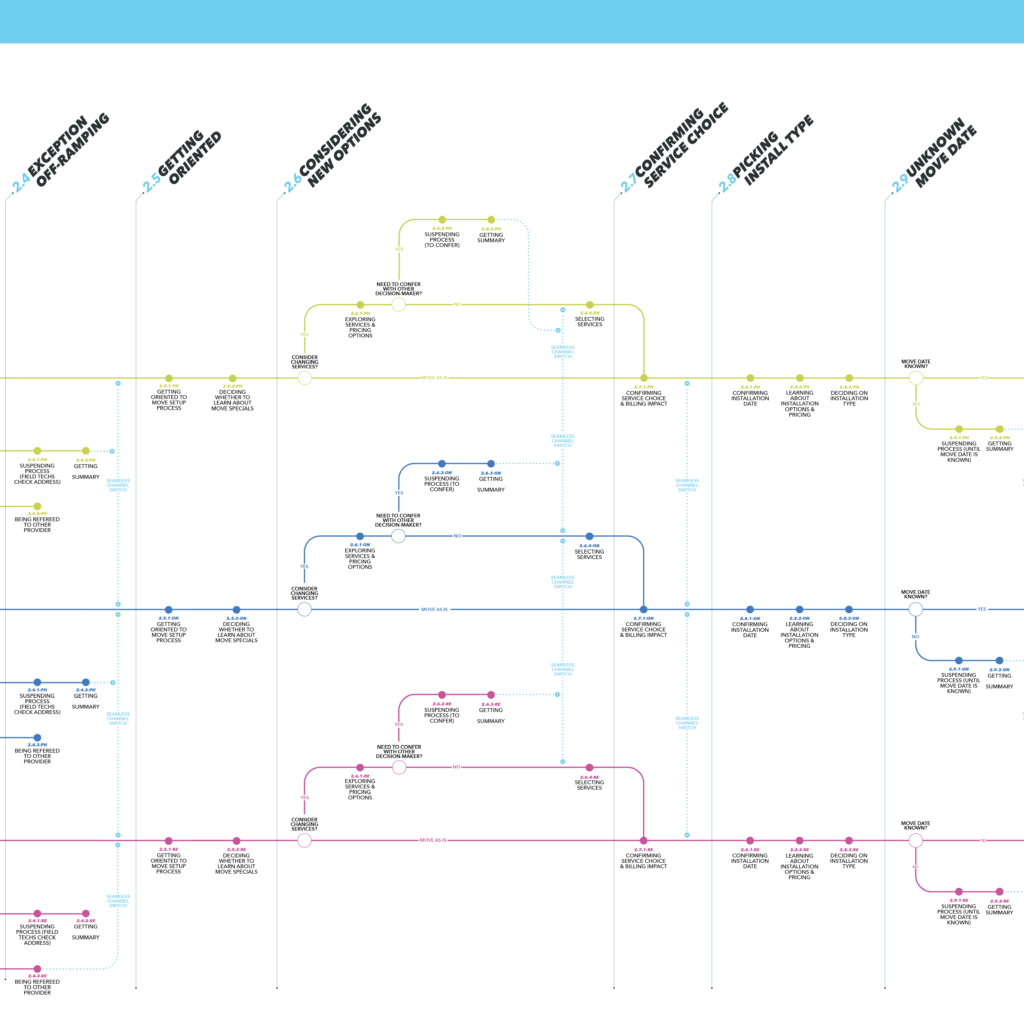
The first service design tool is something we call a Moment Map. A moment map shows all the paths a person can take as they receive a service. Typically, a Moment Map begins with the recognition of a need and ends with the resolution of the need. A Moment Map can depict an existing service, but more often we use them to outline a proposed future service.
A Moment Map shows all the channel paths available to a person receiving the service. By “service channel” we mean the medium by which a service is delivered. A service that is delivered via an app or website can be said to take place in the digital service channel. If you call a call center, the service channel is telephone. If you get in the car and go to a retail space or service center, we might call that the retail space service channel.
Below is an example of a Moment Map.
Moment Map example
The second service design tool is the Service Blueprint. A Service Blueprint follows one customer’s journey through a service step by step, and at each step outlines how the service is delivered. The delivery is divided into a frontstage – what a customer experiences — and backstage, where processes, policies, people and technology platforms are identified. The process of blueprinting produces a list of touchpoints and capabilities DaVita required to deliver an experience like the one described in the journey.
Below is an example of a simple Service Blue Print.
Service Blueprint example
Keep these two service design tools in mind as we move through the second part of the discussion where we metaphor of dimensions to clarify the relationship between service design and other design disciplines.
Part two: Design spaces and their dimensions
To understand the relationship between service design and other design disciplines who collaborate with service designers, for example UX designers, it is helpful to think about it in terms of dimensions.
We’ll start with a single touchpoint.
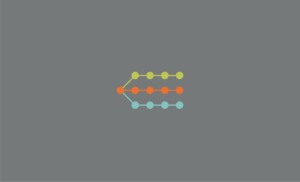
If you recall your elementary school geometry, a point is zero dimensional. When we connect two points, that makes a line. In our model, a touchpoint or a series of touchpoints is an experience that unfolds in time in a single service channel.
So a zero-dimensional touchpoint or one-dimensional “touch-line” is a single channel experience.
The space of single-channel design
Single-channel design problems are well-understood. We have tried-and-true methods for solving them. We have existing team structures, with roles who are used to working together. Many books have been written explaining how to do single-channel design, and how to do it better. This is the kind of problem most designers, such as UX designers spend their time working on.
Most UX designers will tell you that there is more to their work, though, than just focusing on their service channel. To do a good job designing in any service channel it is important to understand the context. We must understand the person for whom we are designing. UXers call them “users”. They might be “customers”, or “patients”, or “employees”, etc. In service design, we like to call them “service actors” or just “actors”. We need to know who they are, what they are trying to do, and we need to understand their needs, attitudes, beliefs, and habits. This is something designers of all kinds always want to know about the people they design for.
We also need to know what they’re doing before they use the artifact we are designing, and what they’ll be doing after. And we also need to know what other touchpoints they’ll be interacting with.
Context of single-channel design
Back in my UX design days, people were always looking for a telephone number to call, just in case they “need to talk to a real person.” And we were always concerned with how people arrived at our digital touchpoints from other channels. What expectations were set?
While UX designers (and other single-channel designers) don’t have direct control over what happens before or after the experiences they are designing, or the experiences their users have in other channels, understanding this before-and-after cross-channel context helps designers create experiences that connect seamlessly and harmonize with the other experiences that make up a user’s overall experience with the brand.
But some design disciplines go beyond understanding, and actively shape the full end-to-end cross-channel experience, for example, omnichannel design, experience design, customer experience design and patient experience design. They look at the whole experience a person has engaging an organization as they zig-zag between channels to accomplish their goals, and ensure that the whole experience at every point is seamless and positive.
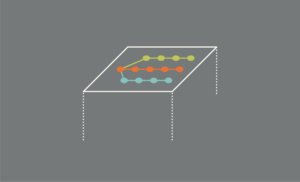
This is where design gains another dimension, and we can think of two-dimensional design, or design of touch-planes.
The space of omnichannel design
Omnichannel design problems are harder to solve than single-channel ones. Methods for solving these problems exist, but they are not as widely known, and are missing altogether in many organizations. Omnichannel design teams include many of the the same people found on UX projects, but many other collaborators with expertise in all service channels also need to be involved, and many of them will be new to design methods might feel uncomfortable. And documenting, updating and activating and managing the omnichannel experience is a capability many organizations are only beginning to develop. Journey Management systems like TheyDo can help companies mature their omnichannel experience management capabilities.
Notice that the first service design tool we saw, the Moment Map, is a visualization of the omnichannel customer experience.
But omnichannel design also has a context which must be understood in order to design effectively. An omnichannel experience is only the tip of an operational iceberg.
Context of omnichannel design
The experience is both enabled and constrained by a company’s capabilities. A company might not have capabilities to deliver a good experience in the channel of choice of a customer. For instance, a customer who “wants to talk to a real person” on the phone might be frustrated by a company that does not operate a call center.
It is is also enabled and constrained by people who deliver and support the experience. Wherever in the experience the motivations of those delivering and supporting the experience are aligned with those of the customer (or other person being service) the experience is likely to be a good experience, but where motivations are misaligned the experience will be marred by friction, frustration and obstacles.
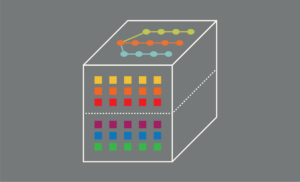
When this operational context becomes part of the design problem itself, a third dimension of design opens. We start thinking about “touch-volumes”.
The space of service design
With this third dimension, we are now in the domain of service design. Service designers not only design the omnichannel experience for the service actor who receives the service. We also design the experience of all other service actors who deliver and support it. This means we must conduct research with all service actors and understand the goals, needs, attitudes, beliefs and behaviors, in order to understand how to align interests and create positive interactions between actors that afford mutual benefit and a good experience.
We also design the capabilities and operations that support optimal service delivery. We want to remove friction and obstacles that might prevent the smooth, efficient and satisfactory delivery, and we want to strategically automate wherever possible to free actors to focus on the more demanding, rewarding or special parts of the service where a human touch enhances the experience.
Notice that the second service design tool we saw, the Service Blueprint, is a visualization of the third dimension, which describes the service delivery of a service.
Part 3: Bringing it together
Once we see how different design disciplines relate using the metaphor of dimensions, we can now look at the two key service design tools, and locate single-channel design projects within them.
What the service design work does is it shows how single-channel touchpoints connect in the context of the larger service. By doing service design, and understanding the omnichannel service experience customers might have, and blueprinting how the service will be delivered, which includes digital tools employees and partners might use to support service delivery, many different UX projects can be coordinated to play various parts in a larger service experience, and that larger service experience is an important context for that design work.
I have been thinking a lot lately about value exchanges, the heart of service design.
In service design we try to arrange things (in the broadest possible sense) so that each person involved in a service — whether receiving it, delivering it on the front lines or supporting it behind the scenes — feels at each moment of the experience that the service is “worth it”.
At every moment of a service each “service actor” — each participant in the perpetually emerging service — invests something valuable in order to receive something even more valuable. “Worth it” is not often a calculation. More often it is a felt intuitive verdict.
As long as every service actor involved feels what they are doing is worth it, the service itself flourishes.
To the degree all the value exchanges that make up a service feel worth it to all service actors, the service works.
To the degree the value exchanges that make up a service feel not worth it to any of the service actors, the service begins to break down. Service actors begin to withdraw, or cheat the system, or they drop out of the service altogether. And the service becomes less and less worth it to any of the actors, until it eventually fails and dies.
Anyone who has ever commissioned, designed, conducted research will find these common but thorny questions all too familiar:
“What is this research going to give us that we can’t get from analytics and iterative design?”
“Don’t you need to ask all your interviewees the same set of questions so you can compare their answers?”
“Can you quantify these findings?”
And with qualitative research, the dreaded: “That’s an awfully small sample. Are these findings statistically significant?”
These questions can be difficult to answer clearly, succinctly and definitively. Wouldn’t it be helpful to have some kind of framework or model to help people understand how the various kinds of research (especially qualitative and quantitative fit together) to provide an organization what it needs to effectively engage and serve their customers?
James Spradley in The Ethnographic Interview provides such a framework. His approach is the identification of four different roles a research participant can play, each with a different relationship between researcher and participant and each producing a different kind of finding:
Informant – In ethnography, a participant is related to as an informant. Informants are “engaged by the ethnographer to speak in their own language or dialect”, providing “a model for the ethnographer to imitate” so that “the ethnographer can learn to use the native language in the way informants do.” The informant is related to as a teacher. What is learned is how the participant conceptualizes and verbalizes his experience. Informants give the researcher not answers to fixed predetermined questions, but the questions themselves. Informants help define what the researcher needs to learn in subsequent research. (Examples of research techniques with informants: unstructured and semi-structured interviews, diary studies, open card sorting, collaborative design exercises.)
Subject – Subjects are participants in social science research, upon whom hypotheses are tested. “Investigators are not primarily interested in discovering the cultural knowledge of the subjects; they seek to confirm or disconfirm a specific hypothesis by studying the subject’s responses. Work with subjects begins with preconceived ideas; work with informants begins with a naive ignorance. Subjects do not define what it is important for the investigator to find out; informants do.” (Examples of research techniques with subjects: usability testing, split testing, concept testing.)
Respondent – A respondent is any person who responds to a survey questionnaire or to queries presented by an investigator. “Survey research with respondents almost always employs the language of the social scientist. The questions arise out of the social scientist’s culture. Ethnographic research, on the other hand, depends more fully on the language of the informant. The questions arise out of the informant’s culture.” (Examples of research techniques with respondents: surveys, questionaires, structured interviews, closed card sorting.)
Actor – “An actor is someone who becomes the object of observation in a natural setting.” As with subjects and respondents, when participants are related to as actors, the terms of the description of the actor’s behaviors are those of the researcher, not of the participant. It should be noted, however, that in ethnographic research (and also in contextual inquiry, participants are interviewed as they are observed, which means the participant is still understood primarily as an informant. The actor-informant teaches the researcher through showing and explaining in his own terms the significance of his actions, which allows the researcher to give (to use Clifford Geertz’s term) “thickness” to his descriptions of what he observes. (Examples of research techniques with actors: site analytics, business intelligence analysis, silent observation.)
Over the course of a research program, research participants may at various times be regarded as subjects, actors or respondents — but if the goal is to know what really motivates the participants, to understand how to engage them at an emotional level, and to cultivate an enduring relationship with them, it makes a lot of sense to begin by relating to research participants as informants, beginning with unstructured or semi-structured interviews.
By starting with an informant relationship with research participants researchers can develop a better idea of what matters to the participants, how they conceptualize and speak about these things, and most importantly how this motivates observable behavior. These insights (that is, findings that illuminate the inner life of participants) can focus subsequent research on the most relevant and impactful questions. It also improves the execution of the research by helping researchers use language that’s natural and understandable to participants, earning greater trust and cooperation, and minimizing misunderstandings. And in analysis researchers and planners will mine more valid insights from the data, since they understand the motives, thought process and language behind the responses and behaviors of the respondents, actors and subjects. And the insights will be accurate because they rely far more on fact than (often unconscious) assumptions.
The other types of research can then report in more quantifiable terms, using much larger samples, how many subjects or actors perform certain behaviors or how many respondents give one answer or another to certain questions on a survey or questionnaire — and these actions and responses will now carry much more meaning because now the researchers have subjective insights to complement the objective data.
Two more points worth making: 1) I haven’t mentioned segmentation in this article, but anywhere where I mention learning about research participants, I am talking about learning about segments of participants (defined by goals, needs, attitudes and behaviors), and understanding the similarities and differences among them. 2) Generally, it is in the role of informant that research participants provide findings that drive design and creative. Informants inspire empathy and creative approaches. Subjects, respondents and actors tend to yield information useful in making strategy decisions. Using the full range of qualitative and quantitative research methods together intelligently can enable strategists and designers to work together more effectively to harness the full power of experience design.
By understanding research better — recognizing the difference between research that produces subjective insights and research that produces objective data, by not mistaking them for rival methods for producing the same kinds of findings, and by understanding how they can be used together to gain a holistic picture of one’s customers that is far more than the sum of the facts — an organization becomes more capable of understanding its customers without sacrificing their individuality to empty statistics.
When people ask me what design research is, my favorite answer is “precision inspiration”.
I know this might seem slightly business romantic, but my meaning is exact, clear, concrete — even a bit technical.
*
I’ll start by explaining what research is pragmatically, in terms of what it does. And because I’m a business guy, I’ll explain what it does in terms of its benefits. In other words, I’ll start with a sales pitch.
First, design research helps inform decisions. It helps teams identify opportunities for improvements. It helps us understand what should be improved, why that improvement will matter to people and how the improvement ought to be made so that the work has its intended effect. Design research helps organizations “design the right thing, and to design the thing right.” Research improves the product.
Second, design research also provides persuasive evidence that helps leaders align organizations around particular projects. If everyone in an organization is persuaded that a project is worthwhile, energy otherwise wasted arguing for following divergent paths — or even taking those paths and working at cross-purposes — is applied forcefully in a single direction. And morale-sapping doubts about the project can be quelled, so participants can invest real energy into the project, in the expectation that their efforts will produce a positive outcome. Design research done well is organizational alignment magic. Research improves the efficiency of production.
Design research also drastically improves team dynamics and helps them collaborate more effectively and enjoyably. By introducing the scientific method into design processes, it brings enlightenment values to the notoriously authoritarian milieu of the workplace. Instead of uninformed speculations and untested intuitions (the products of private imaginations, prejudices, preconceptions and biases) competing to prove that it possesses esoteric insights into the souls of The User or The Customer and therefore has the answer on what solution to build, everyone is free (or freer) to propose questions to ask and hypotheses to test with real people, in order to assess the degree of validity in everyones’ ideas and hunches. The stakes are lower and cheaper, so democratic participation is more affordable. And the output of the research typically partially validates multiple views in ways requiring new combinations. So ingenuity is contributed from more sources and woven together ingeniously by yet others, and ultimately the idea can only be said to originate in the entire team working together on a shared problem. Research improves the experience of production, which gets us closer to the climax of my pitch, the inspiration part.
The inspiration of design research comes from how it can helps us reconceive what we are doing, how we are doing it and why it matters. This is important, because our repertoire of conceptions enable and constrain what we think, believe, imagine, invent. They also shape our perceptions and help us ask clear questions. The limits of our conceptions are the limits of our minds, and our ability to take intelligent action. In the most productive research, new concepts are learned directly from participants in the research, in the process of understanding their worldviews. Yet more conceptions must be found/made (or “instaurated”) to make sense of the full range of concepts learned and link them to the conceptual tools of the various disciplines collaborating on a solution. This can rarely be done with the available stock of existing conceptions, so, in effect, teams are forced to create new conception systems — small, local philosophies tailored to a project — that makes problems intelligible and soluble.
This is an arduous, perplexing and anxious process. Not all people have the intellectual flexibility, faith and fortitude to do it. But when it is done successfully, new possibilities pop into existence, ex nihilo, that were literally inconceivable before. This sudden influx of possibilities and outpouring of novel ideas resulting from the acquisition of new concepts is in fact what inspiration is.
The novel ideas produced by research are far less obvious and far more relevant (because they were acquired through understanding users or customers) than ideas produced by industry conventional wisdom that, because it processes the same old facts the same old way, produces nothing but the same old same-old, safe, stale, predictable, undifferentiated ideas.
Deep, rigorous, courageous research is the most effective and reliable way to induce such precision inspiration.
Sometimes, rapport is treated as a means to an end. We try to have relaxed, natural, flowing conversations because this encourages our participants to respond more candidly. We get richer, deeper, more extensive and honest data. All this is true.
But rapport gives us something else. It helps the researcher attune to the participant’s world, and understand what is being said in light of this attunement. The goal of deep rapport is not only better data but a better understanding of the significance of that data.