Knitbone Manifesto

Part 1: The Hidden Costs of Carrot and Stick Management

Most organizations, as mechanically efficient as they aspire to be, motivate people very wastefully.

Instead of understanding people’s natural intrinsic motivations — their sources of meaning, fulfillment, inspiration, resilience and endurance — they rely on artificial extrinsic motivations. These positive and negative external motivations are often referred to as “carrots and sticks”.

No organization can entirely dispense with external motivations, for the simple fact that many employees are largely externally motivated. But some are not, and when employees who are internally motivated cannot find an outlet for them, and are managed as if they must be externally motivated, bad things happen, which we will discuss.

Let us call the habitual overuse of external motivations “carrot and stick management”.

Instead of creating conditions where people have opportunities to do the kind of work they feel called to do, carrot and stick management prefers bribes, blackmail and psychological manipulation to extract behaviors from their human resources.

Here are some downsides to carrot and stick management:

First, there is the expense of the carrots and sticks themselves. When work is a labor of love, people naturally work tirelessly just for the reward of doing it. When work is a labor of getting paid and not suffering consequences of noncompliance, pay must increase accordingly. Penalizing noncompliance also is not cheap; it requires documented processes. Carrot and stick management squanders cash on artificial motivations required to make folks do what they don’t want to do because natural motivations are lacking.

Second, carrot and stick requires considerable bureaucratic overhead, which is costly to create and maintain. In order to properly reward the desired behaviors and to correct or punish undesirable ones, managers must monitor those behaviors. They must build expensive technologies, establish reporting processes and enforce compliance, because these are dull activities people avoid if they can. Carrot and stick management squanders money and time on artificial motivation technologies and processes.

Third, carrot and stick management wastes an organization’s deepest and best resources — passions that, if channeled into the work, could infuse energy and vibrancy into the organization. Instead these passions are channeled into evenings, weekends, vacations and hopes for a better career elsewhere, where they are valued. The organization, instead of benefitting from these gifts, is resented for rejecting, undermining and obstructing them. And people are left feeling coerced, dehumanized, devalued and unfulfilled, which, for obvious reasons, is corrosive to an organization’s culture and contributes to turnover. Carrot and stick management squanders employees’ and partners’ morale, energy and desire to give.

Finally, demoralized people are demoralizing to interact with. Even if they stay at a job they don’t like and try with all their might to hide their feelings or numbness, they’ll behave in a spiritless, artificial and slightly phony, scripted way. They feel “corporate” in the worst sense of the word, and even the most perfectly executed corporateness is impossible to like. Brands that feel corporate do not inspire positive feelings or personal connection, and undermine brand relationship. Carrot and stick management squanders brand equity.


Part 2: Lessons of the Knitbone

Knitbone is the folk name for the comfrey plant (Symphytum officinale), a plant prized for a great many useful properties.

Traditionally, it has been used medicinally, especially to make poultices which help a wounded body heal itself. A knitbone poultice applied to a broken bone helps it knit itself back together. When my wife gave birth to our first daughter, our midwife prepared a poultice from knitbone we grew in our own back yard garden to help her recover.

But the knitbone used in the poultice had been planted for an entirely different purpose. We planted it in order to improve the soil in our herb garden.

The leaves of the knitbone are extraordinarily rich in minerals, and when they shed and fall onto the ground, they enrich the soil. They create a sort of fertile poultice for the plants around it. A knitbone ripples rings of vitality into all neighboring plants, which is why gardeners plant knitbone throughout their gardens.

Why does the knitbone have this effect on living things? The secret is its roots. When a knitbone is planted, it drops a taproot into the ground, which burrows into the earth, deeper and deeper, sometimes ten feet or more into layers of earth otherwise unreachable, drawing obscure, buried resources up to the sunny surface, where they can be accessed by other plants, animals and human healers.


Part 3: Restart with Whys

My essential service is understanding other people’s driving Why — those natural intrinsic motivations that give a person a sense of fulfillment and life purpose.

Before we can understand what a driving Why is we need to understand what it means to ask a why question.

Because most of us suffer a kind of philosophical color-blindness. Just as the retina of a color-blind person is missing a color receptor, our vision of work is missing a whole category of understanding.

We lack a Why receptor. We have only What and How receptors.

So when we ask Why, we perceive only a What-How answer. We expect an in-order-to response.

Why do you go to work? In order to get paid. Why do you need to get paid? In order to pay my bills and build savings. Why do you need to pay your bills? Why do you need to save money?

Of course, most of what we normally do all day is stuff we do in order to do other stuff, in order to… in order to…

And that is fine, as long as one condition is met: the in-order-to chain is grounded in something that is done for its own sake. It is done for no other reason except its own value.

Here there is no in-order-to. The answer to Why is “I cannot say why.” It is what I do. It is what gives my life purpose. I do it because I love it.

This is what the question Why seeks, and the response cannot be given in language. It is given in feeling and action. Words, at best indicate it, but when they are expected to give that Why, the meaning is lost entirely.

But if a person’s chain of in-order-to is plugged into Why it is all charged with significance. A person feels motivated to do x in order to do y, and z when the connection with Why is felt.

Further, an organization where Why is felt by enough people also enjoys a purposeful culture. Meaning is in the air and infuses the work, even for people who are largely externally motivated. The activities, expressions and outputs of internally motivated people enrich the soil of the organization, and the culture of the organization is nourishing.

People are not motivated by the slogans or mission statements or strategies or justifications of strategies. They are motivated by the energy, the sense of purpose, of importance, the atmosphere of intrinsic motivation.

To achieve this, it is of the highest importance for organizations to start accounting for their stores of intrinsic motivations, and ensure they aren’t wasting or blocking them.

It must understand where these driving Whys may naturally be designed into its operations, so they drive the organization in the direction it is trying to go. And so these driving Whys animate its interactions with customers, who feel and appreciate its charismatic sincerity.

It also must understand where people need these gifts from others — where someone who needs to be needed in a particular way — who wants to give their essential service — can serve another person who needs it. Whether this happens externally — for example when a customer who needs technical assistance is helped by someone who feels personal fulfillment using their expertise — or internally — for example a junior employee is mentored by a senior leader who wants to share her hard-earned wisdom — an internal exchange of value is a win-win.

These win-win points are the energy generators in an organization. This is where the organization provides opportunities for people to give what they need to give, and receive what they need to receive. This is where people feel gratitude and loyalty to one another and to the organization that mediated the exchange.

The choreography of these win-win value exchanges, and all the other value exchanges that power the human interactions that constitute the organization is the very heart of the work service design does.

Service design shapes, as its material, everything that makes up an organization, so it can mediate value exchanges among those who participate in it, whether receiving its products and services (as a customer) or delivering or supporting it. Whatever various materials are used, what sets the whole system in motion — what animates it and gives it vitality — is the exchange of value.

The material of service design is organizations; its medium is exchange of value, and the most vivifying value, the lifeblood that makes the system a living organic system and not a soulless mechanical system, is the driving Whys, the essential services that come from people who have found purpose serving within the organization.

AI and service design

Service design’s basic schtick is backwards planning from the human to the technical:

  • from behaviors that make an organization flourish, to positive value exchanges that might motivate these behaviors,
  • from positive value exchanges to good experiences that occasion such value exchanges,
  • from good experiences to service operation systems capable of delivering good experiences,
  • from service operation systems to capability requirements that make the operations possible,
  • from capability requirements to initiatives to develop the capabilities and actualize them.

This, of course, is exactly the opposite of business-as-usual, which goes more like this:

  • from ad hoc development of functional capability in response to momentary need,
  • to hacking together of functions with technical integrations and manual processes,
  • to attempts to patch up the worst customer pain points as they impact the business,
  • to marketing spinning what ensues in order to attract customers faster than they leave,
  • to colliding with the shocking reality that nobody’s motivated to do what the organization needs them to do.

An innovation tragicomedy: Business is never more business-as-usual than when it becomes enamored or panicked or otherwise fixated on some new technology.

Everyone falls all over themselves in the headlong rush to prematurely answer the wrong question, which is: “How do we leverage this new thing?”

A better question is “What is the ideal for our organization and for the people who make it flourish by participating in it? How can we approach this ideal more perfectly — or even surpass it — using new capabilities enabled by this new technology?”


Right now everybody is service designers, “How does AI figure into service design?”

My answer is pretty simple. AI enters the process as another capability. By capability, I mean an enabling role or policy or process or technology.

And capabilities fit in a specific place within a longer sequence of questions — the sequence I outlined earlier.

We ask ourselves, “What do we need to happen here at this point in the service?”

We then ask, “What do we want each person to do? What do we want the customer to do? What do we need our employees to do to get the customer to behave as we hope?”

And we ask these questions through the lens of value exchange: “What are they after in this moment? What are they willing to put into it in order to get it?”

Then we ask, “What are the conditions required to actualize this value exchange? What makes this exchange and these behaviors happen?” This is where capabilities are defined.

And here is where we finally ask what everyone wants to ask too soon: “Can AI make this happen, or help make it happen, in the most effective and efficient way?”

What makes AI a little different is that it appears more as a role or process capability than as a traditional technology. But the good news is that service design doesn’t care much about this kind of blurring. AI can play the role of a person, but without the need to consider value exchange. It doesn’t care what it puts in or what it gets out of the interaction. Depending on context, this stakeless selflessness can seem altruistic or alien, and this should inform whether AI or human agency is the better choice. But the point here is that an AI role, like any human role, is a unit of agency constrained and enabled by role responsibilities, policies, processes and technology. And defining and coordinating agency has been central to service design from its earliest origins as a discipline.

Service design is the design discipline best positioned to help organizations make wise and pro-human use of AI.

Yes-anding “design is the rendering of intent”

Many designers have adopted Jared Spool’s definition of design: Design is the rendering of intent.

Over the last year, we’ve started explaining design as “the rendering of intent.” The designer imagines an outcome and puts forth activities to make that outcome real.

We’ve found this definition seems to resonate with people more than any other. People can see the relationship between the intended outcome and the process that renders it.

There is much to like in this definition. It is crisp, compact and elegant.

The definition is broad but still meaningfully constrained. Design renders but does not execute, produce or otherwise actualize the intent. The rendering specifies a future actualization.

The more I reflect on it, the more I like this definition — at least as the most universal definition of design.

Anyone who says they are designing anything means at least this.


My only question concerns whether this definition of design really answers the question people are asking when they ask professional designers what they do.

For some time now, it has been de rigueur to claim that, because everyone designs, everyone is a designer.

Spool affirms this explicitly:

An implication of this definition for design is how it changes our notion of who is a designer.

In any organization, many people share what they’d like to see as the intentions of the design. The business people have intentions with regards to how the business makes money. The technical people have intentions to best use servers, networks, and other technical resources. The legal team has intentions on how to best protect the organization from legal threats.

As these people use their influence to define the outcome of the design, they are, in effect, designing. There’s an old saying, everyone thinks they are a designer. Well, everyone who participates in the rendering of their intention is a designer, using this definition.

So by Spool’s definition (and also Herbert Simon’s, Nigel Cross’s, etc.) everyone does render intent, or devises a course of action meant to turn an existing situation into a preferred one, etc. Whenever we make a shopping list we are designing an upcoming trip to the store. Whenever we plan our day we are designing it. What could possibly render intent more than a checklist?

For Spool, the main difference between the design that designers do and the design that all people do is what the intentions include. Designers intend experiences:

Experiences are the journeys that people take before, during, and after coming into contact with our design. We can choose our intentions for what we want our users’ journeys to be. And when we render those intentions, we’re designing for our users’ experiences. Experience design is rendering intentions of the user’s journey.

But here is the problem. Does Spool’s general definition of design really get at what people are implicitly wondering when they ask designers what they do?

Does anyone wonder this way about making plans or shopping lists? I suspect not. Even narrowing the definition of design to what engineers mean when they talk about designing (for example, an algorithm, microchip or suspension bridge) seems to miss something essential. Do people really wonder what engineers are doing when they do engineering design? I seriously doubt it.

Not to get meta, but questions of exactly this kind — questions concerning focus of interest, about different qualities of various experiences, including experience of curiosity, of implicit questions animating explicit questions — are all examples of the kind of thing designers must think about when practicing design that focuses on experiential intent.

Spool deemphasizes the essence of design, and elides the heart of the question, in the effort to provide an accessible definition to non-designers.

It is the experiential intent that a designer’s work is all about. It is this experiential intent — not intents in general — that gives the kind of design that designers do its aura of elusive significance. These are what motivate questions about what design is. People aren’t requesting a compact definition of a general field of activity. They are asking for insights into a field of work that feels important in an elusive way they can’t quite pin down.

The definitions offered by Spool, Simon, Cross and the rest neglect this essential difference, and do less than nothing to elucidate it. They answer a question, but not the relevant one. These answers falsely demystify design. Rather than elucidating the mystery, they suppress and flatten it.

To put it in philosophical language, these general definitions of design identify necessary conditions of all activities that are referred to as designing, but are insufficient to define or clarify what designers do.


But this isn’t just a theoretical philosophical problem. It isn’t idle definitional hair-splitting. It is a practical problem with extensive consequences. Experiential intent changes everything.

Designing across subjective difference is an essentially different activity than planning something that can be understood objectively. The inclusion of subjective factors changes why design matters, and how the work must be done and what conditions and resources are required to do it well.

If experience design is taken as just one more variation on rendering intent, differing only in the scope of the intention, it is natural to assume the activity is essentially like making a checklist or producing a schematic of a microchip. It is reasonable to assume that it involves the same kinds of activities, and differs mainly in what expertise gets applied to the intent-rendering problem.

And if you listen to designers about what gets in the way of good design, you will hear exactly this misconception behind it. The process of shaping an experience another person will have introduces challenges other intent-rendering fields do not face. Designers need iterative contact with the people for whom the design is intended, both to inform the intention and to ensure that the experience will actualize as intended. Further, the process of shaping experiences involves developing systems, but not only that. It also must make sense to people, it must matter to them, and it must be intuitive to deal with — and different people respond very differently to things.

The flattening of design into something like the planning activities of managers and the system-construction activities of engineers simplifies the challenges designers face, and pushes them back into designing things instead of experiences.


Everyone might render intent, but not everyone renders experiential intent.

And rendering experiential intent requires a deep shift in understanding that very few people have undergone. It requires a pluralistic capacity — at minimum an ability to intersubjectively switch between alternate objectivities — and ideally, a capacity to conceive entirely new ones.

It is precisely this capacity that gives design its mysterious importance.

It is a mysterious importance that is felt as different from the utilitarian importance of business people rendering their intentions of making money for the business, or technical people rendering their intentions to use servers, networks, and other technical resources effectively.

And, as Spool himself describes, experience designers must coordinate all these intent-rendering activities so they contribute to rendering an experiential intent.

If designers stop doing this, they may still claim to design in the general sense, but they are not designers in the sense that intrigues and provokes questions. They are planners, list makers and system constructors.


And now with service design, experiences are no longer intended for solitary people, like users or customers or patients and so on. Service designers intend experiences that multiple persons with differing (and potentially conflicting) goals, understandings, attitudes and sensibilities will experience together simultaneously. Part of what these people experience is each other in their various roles in the experience. Polycentered design requires capacities of another order beyond that of mono-centered design fields.

Polycentered experiences (that is, experiences with multiple first-person centers) motivate behaviors that collectively produce emergent properties in social systems (polycentric systems with multiple independent agentic centers, a la Polanyi and Ostrom).

10,000 foot view of service design

When I first began doing service design, one challenge I faced was the problem of granularity. The granularity appropriate to solving service design problems was hard to pin down and fluctuated widely. One minute we’d address some overarching problem that occurred across a whole service experience, and in another we would focus on a small but crucial moment. We seemed to be zooming in and out, and looking at the experience from a range of altitudes. It was difficult to explain why.

In design, thinking about altitudes and zoom levels is common to the point of being a tradition, starting with the Eameses’ classic “Powers of Ten” film. Given its strategic, integrative, multidisciplinary scope, Service Design is particularly zoomy, so it is unsurprising that altitude-based frameworks and analogies are frequently used in the Service Design world.

As important as it is to understand the value of working at multiple altitudes, it is also helpful to be prepared for the experience of changing altitudes, especially within Service Design’s own peculiar range. For the uninitiated, the shifts in granularity, theme and perspective can be a slightly strange experience. As a sort of expectation-setting initiation, I offer an extended, but hopefully not too labored, analogy.

If strategy flies at 30,000 feet (where the ground is so distant it looks like a map) and we agree most design flies at 3 feet (where the ground is so close and so chaotic it is hard to survey), service design flies at 10,000 feet, approximately the cruising altitude of a single-engine prop plane.

10,000 feet is a very useful altitude that bridges 30,000 foot and ground — clarifying relationships between strategy, operations and the experiences real people (real customers, real employees) have as a result — but flying at this altitude does introduce practical challenges.

First, there is the issue of clouds. At 30,000 feet, the clouds are below you. Standing on the ground, the clouds are above you. But at 10,000 feet you are flying in and out of clouds, which can be very disorienting, in the most literal sense. It can be tricky to know which way you are facing or which way is up. And the view is neither clear nor continuous. One moment you can see a bit of ground, the next you see nothing but your instruments, and you have to use your memory, imagination and your recording and data-gathering tools to form a sense of the whole. But the understanding that develops from these varying sources has far more structural clarity than you can get from the ground, and more human richness than you can detect way up in the cold, thin air of the stratosphere. To put it all together, though, interpretation is necessary. The picture doesn’t automatically emerge by itself. The heterogeneous parts must be skillfully pieced together into a coherent image.

Second, you are dealing with some odd scales of meaning. Looking down at a town, everything looks miniaturized but still human, maybe even exaggeratedly human because the tedium of life is abstracted away and we relate to it like kids playing with toys. Some homes are big, some are small, some are complexes or towers. Some are arranged in grids, some along windy branches of street bulbing in cul-de-sacs, and some cluster along the edges of lakesides or hills. Some homes have trees or yards, pools, trampolines or gardens, driveways or parking lots. You can imagine what life in the neighborhood might be like. But you can also see the layout of the city, and get a sense of how parts of the town connect up. You can see where the schools, the stores, the churches and the sports fields are. You can see where things have been built up, what has been left in a wild state, and where development is happening.

Now, imagine telling a story about the life you see below, doing justice both to the individual lives taking place in the tiny buildings below and showing how it all connects to form a system… this is not the usual storytelling scale. It is neither intimate nor epic. It must generalize, but without blurring key particularities or averaging individuality into bland anonymity. But if you wish to tell the story of how a town works, or if you want to propose significant structural modifications to the town, this is the narrative scale required. Telling such a story requires thoughtful zooming in and zooming out to show connections between whole and part, connecting fine grain details of breakfasts, meetings and bills, with grander-scale phenomena like demographic trends, commerce and traffic patterns. Translated back to Service Design, this means combining stories of cultural and industry trends, corporate strategies and vignettes from customers’ and employees’ lives to show how these macro-level trends and strategies impact the everyday existence of individual people, and conversely, how the micro-level behaviors impact strategies and generate trends.

Finally, intervening at this height is strange. Many proposals for change fall somewhere between strategic and tactical. They anticipate details of implementation, but without over-specifying them. Specifications are suggestive and provisional and intended more to clarify a problem than provide a solution. Many people find the interpretive latitude confusing: what in the recommendation is fixed and what is variable? If everything is open-ended what use is the recommendation at all? It can all seem vague and insubstantial, yet there is a thrust and lasting momentum in the work that carries initiatives forward and in a direction that benefits the organization as a whole, its employees and the people it serves. Somehow the recommendations made from this altitude are capable of creating continuity between the grand plans of strategists and the intricacies of implementers on the ground.

The 10,000 foot view manages to refract the grand plans and sweeping aspirations of the 30,000 foot view into actions on the ground that actualize them and prevent them from remaining mere aspiration and plan. And the 10,000 foot view provides individual actors on the ground a way to relate and connect their efforts to tangible, relatable and realistic goals that connect up with the purpose of the organization.

*

The “material science” of people

My dad is a retired ceramic engineering professor. He is what many people would call “extremely left-brained”. He is the kind of guy who stays up late into the night doing math puzzles for fun. Engineering has always been a core part of his personal identity, even after he became a professor. For him teaching was a process of making new engineers. His job was to take unformed high school graduates and transform them into good engineers, capable of tackling the toughest problems with knowledge, ingenuity, tenacity and a dash of principled impishness.

Like many highly analytical people, my dad tends to view design as a mostly subjective domain, dealing with aesthetic taste and feelings, as opposed to the kind of objective problem-solving engineers do.

This misconception of design is not uncommon. It is especially prevalent in engineering-led organizations. And since designers spend much of their time collaborating with engineers this misconception has practical consequences.

So changing my dad’s view on design and its relationship to engineering seemed like an interesting challenge, and one that might even help solve some tough real-world problems.

I tried several approaches. I talked to him about theory. I explained human-centered design methods. I told him stories about projects. I tried to convey to him what I find fascinating and frustrating about design problems. None of it clicked with him. So, I backed up and reframed my communication challenge as a design problem. I knew if I wanted him to adopt my concept, I would have to make it intuitive, which meant connecting it to his own experiences and using as much of his vocabulary as possible. Here is what I came up with:

Back when he was teaching, some of the most important classes he taught were on material science. His students learned the properties of different kinds of ceramics under varying conditions, such as heat, pressure, stresses of various kinds, etc.), and how to apply this knowledge to solve engineering problems. Because good engineers build systems out of well-understood materials with predictable characteristics.

I explained to him that designers face a similar situation, except our systems include not only physical parts, but also human participants, which we, like engineers, need to understand thoroughly in order to solve the kinds of problems designers are hired to solve. Our problems involve getting people to respond in some particular way to what we are making. Insights into how our human participants think, feel and behave in different conditions helps us develop systems that inspire the right kinds of participation in our systems. Participation might be nothing more than noticing some artifact and forming a positive impression. It might be adopting a tool and using it skillfully. Or it might be actively engaging and actually using a service.

Yes, aesthetics, taste, feelings and subjectivity are an important part of our job, but we are interested in how they coalesce into a person who will experience what we are making and respond with feelings, thoughts and actions that support the overall system we are developing. And that system is made up not only of the participants, but also non-human parts — the parts engineers build.

So, to summarize: design research is the material science of design. In material science, the goal is to understand the rules that determine behaviors of materials, so that when an engineer uses them in a system they predictably function as intended; in design research the goal is to understand the factors that influence certain types of people to feel, think and act, so if someone of that type encounters a design they will predictably respond as intended.

This seems to work well enough for its intended purpose. But unexpectedly, it started working on me as well. Since conceiving design and design research this way, the logic of the explanation has taken on a life of its own, and it has changed my own understanding of what design essentially is.

Win-win engineering

Organizations live or die by human behaviors.

If the leaders of a company behave in a way that inspire, encourage coerce or otherwise motivate behaviors within the organization that efficiently and effectively motivate partners and customers to behave in ways that support the organization’s goals, that organization will flourish.

If leaders motivate the wrong behaviors or fail to motivate the right behaviors, and if behaviors within the organization fail to support or undermine an organization’s goals, or if they do so inefficiently or ineffectively, and if, consequently partners and customers stop engaging with the organization, that organization will fail.

Service design begins and ends with behaviors. It begins with what people are currently doing, and it inquires into why people behave the way they do. It ends with systems of behavior that cause an organization to flourish. And it looks for ways to make people want to behave in organization-supporting ways, and to willingly and spontaneously support it because that organization supports what they want.

The best service design inspires genuine loyalty.

I’ve called service design “win-win engineering”.

Undiagnosed design problems

I describe my career path “zigzagging”. I’ve had the pleasure of working across an unusually wide range of design disciplines — visual, communication, UX, industrial, environmental, service, instructional.

One of my favorite zags was through strategic design, when I began solving “undiagnosed design problems”.

Many problems that appeared to be intractable political, management or process problems became way, way more tractable when approached as design problems.

Any problem that involves people participating in systems, where the success of that system depends on people choosing to participate in particular ways is a design problem.

But doesn’t that mean most social and organizational problems are design problems? Yes!

Dimensions of service design

Service designers are often asked how what they do relates to what other designers, especially UX designers, do. My colleagues have been asked this question by clients, and it seems a new article on this question pops up every couple of months. Everyone has their own way of answering the question. My favorite way of explaining it has three parts.

  1. I start by showing two tools service designers use that give a concrete indication of what makes us different.
  2. Then I use a metaphor of dimensions to clarify how different design disciplines relate.
  3. I finish by returning to the two service design tools, and make the relationship both clear and concrete.


Part one: Two key service design tools

To begin, I will show two tools service designers use.

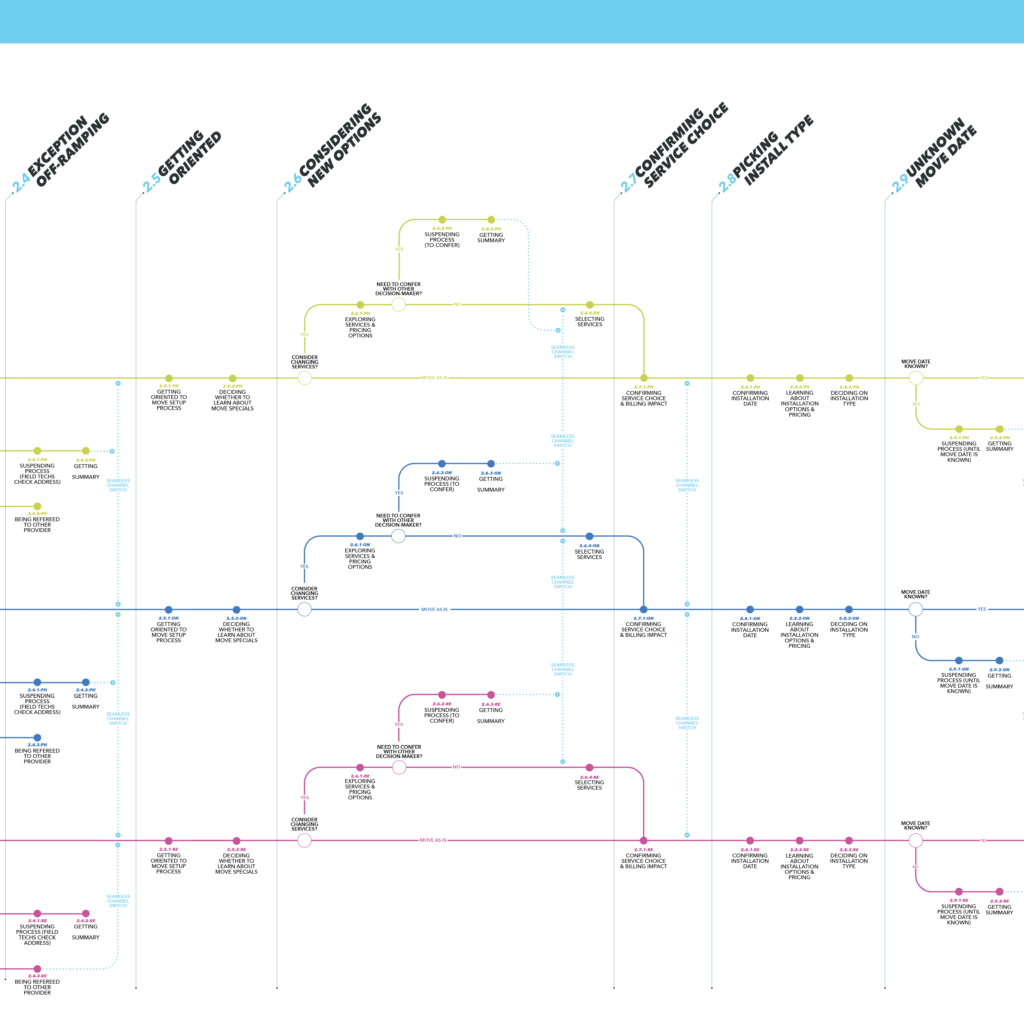
The first service design tool is something we call a Moment Map. A moment map shows all the paths a person can take as they receive a service. Typically, a Moment Map begins with the recognition of a need and ends with the resolution of the need. A Moment Map can depict an existing service, but more often we use them to outline a proposed future service.

A Moment Map shows all the channel paths available to a person receiving the service. By “service channel” we mean the medium by which a service is delivered. A service that is delivered via an app or website can be said to take place in the digital service channel. If you call a call center, the service channel is telephone. If you get in the car and go to a retail space or service center, we might call that the retail space service channel.

Below is an example of a Moment Map.

Moment Map example

The second service design tool is the Service Blueprint. A Service Blueprint follows one customer’s journey through a service step by step, and at each step outlines how the service is delivered. The delivery is divided into a frontstage – what a customer experiences — and backstage, where processes, policies, people and technology platforms are identified. The process of blueprinting produces a list of touchpoints and capabilities required to deliver an experience like the one described in the journey.

Below is an example of a simple Service Blue Print.

Service Blueprint example

Keep these two service design tools in mind as we move through the second part of the discussion where we metaphor of dimensions to clarify the relationship between service design and other design disciplines.

Part two: Design spaces and their dimensions

To understand the relationship between service design and other design disciplines who collaborate with service designers, for example UX designers, it is helpful to think about it in terms of dimensions.

We’ll start with a single touchpoint.

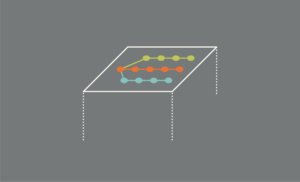
If you recall your elementary school geometry, a point is zero dimensional. When we connect two points, that makes a line. In our model, a touchpoint or a series of touchpoints is an experience that unfolds in time in a single service channel.

So a zero-dimensional touchpoint or one-dimensional “touch-line” is a single channel experience.

The space of single-channel design

Single-channel design problems are well-understood. We have tried-and-true methods for solving them. We have existing team structures, with roles who are used to working together. Many books have been written explaining how to do single-channel design, and how to do it better. This is the kind of problem most designers, such as UX designers spend their time working on.

Most UX designers will tell you that there is more to their work, though, than just focusing on their service channel. To do a good job designing in any service channel it is important to understand the context. We must understand the person for whom we are designing. UXers call them “users”. They might be “customers”, or “patients”, or “employees”, etc. In service design, we like to call them “service actors” or just “actors”. We need to know who they are, what they are trying to do, and we need to understand their needs, attitudes, beliefs, and habits. This is something designers of all kinds always want to know about the people they design for.

We also need to know what they’re doing before they use the artifact we are designing, and what they’ll be doing after. And we also need to know what other touchpoints they’ll be interacting with.

Context of single-channel design

Back in my UX design days, people were always looking for a telephone number to call, just in case they “need to talk to a real person.” And we were always concerned with how people arrived at our digital touchpoints from other channels. What expectations were set?

While UX designers (and other single-channel designers) don’t have direct control over what happens before or after the experiences they are designing, or the experiences their users have in other channels, understanding this before-and-after cross-channel context helps designers create experiences that connect seamlessly and harmonize with the other experiences that make up a user’s overall experience with the brand.

But some design disciplines go beyond understanding, and actively shape the full end-to-end cross-channel experience, for example, omnichannel design, experience design, customer experience design and patient experience design. They look at the whole experience a person has engaging an organization as they zig-zag between channels to accomplish their goals, and ensure that the whole experience at every point is seamless and positive.

This is where design gains another dimension, and we can think of two-dimensional design, or design of touch-planes.

The space of omnichannel design

Omnichannel design problems are harder to solve than single-channel ones. Methods for solving these problems exist, but they are not as widely known, and are missing altogether in many organizations. Omnichannel design teams include many of the the same people found on UX projects, but many other collaborators with expertise in all service channels also need to be involved, and many of them will be new to design methods might feel uncomfortable. And documenting, updating and activating and managing the omnichannel experience is a capability many organizations are only beginning to develop. Journey Management systems like TheyDo can help companies mature their omnichannel experience management capabilities.

Notice that the first service design tool we saw, the Moment Map, is a visualization of the omnichannel customer experience.


But omnichannel design also has a context which must be understood in order to design effectively. An omnichannel experience is only the tip of an operational iceberg.

Context of omnichannel design

The experience is both enabled and constrained by a company’s capabilities. A company might not have capabilities to deliver a good experience in the channel of choice of a customer. For instance, a customer who “wants to talk to a real person” on the phone might be frustrated by a company that does not operate a call center.

It is is also enabled and constrained by people who deliver and support the experience. Wherever in the experience the motivations of those delivering and supporting the experience are aligned with those of the customer (or other person being service) the experience is likely to be a good experience, but where motivations are misaligned the experience will be marred by friction, frustration and obstacles.

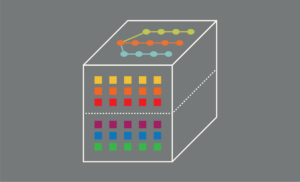
When this operational context becomes part of the design problem itself, a third dimension of design opens. We start thinking about “touch-volumes”.

The space of service design

With this third dimension, we are now in the domain of service design. Service designers not only design the omnichannel experience for the service actor who receives the service. We also design the experience of all other service actors who deliver and support it. This means we must conduct research with all service actors and understand the goals, needs, attitudes, beliefs and behaviors, in order to understand how to align interests and create positive interactions between actors that afford mutual benefit and a good experience.

We also design the capabilities and operations that support optimal service delivery. We want to remove friction and obstacles that might prevent the smooth, efficient and satisfactory delivery, and we want to strategically automate wherever possible to free actors to focus on the more demanding, rewarding or special parts of the service where a human touch enhances the experience.

Notice that the second service design tool we saw, the Service Blueprint, is a visualization of the third dimension, which describes the service delivery of a service.

Part 3: Bringing it together

Once we see how different design disciplines relate using the metaphor of dimensions, we can now look at the two key service design tools, and locate single-channel design projects within them.

What the service design work does is it shows how single-channel touchpoints connect in the context of the larger service. By doing service design, and understanding the omnichannel service experience customers might have, and blueprinting how the service will be delivered, which includes digital tools employees and partners might use to support service delivery, many different UX projects can be coordinated to play various parts in a larger service experience, and that larger service experience is an important context for that design work.

It’s all about value exchanges

Value exchanges are the heart of service design.

In service design we try to arrange things (in the broadest possible sense) so that each person involved in a service — whether receiving it, delivering it on the front lines or supporting it behind the scenes — feels at each moment of the experience that the service is “worth it”.

At every moment of a service each “service actor” — each participant in the perpetually emerging service — invests something valuable in order to receive something even more valuable. “Worth it” is rarely a calculation. More often it is an intuited and felt verdict.

To the degree all the value exchanges that make up a service feel worth it to all service actors, the service works as intended and everyone flourishes, including the sponsoring organization.

To the degree value exchanges do not feel worth it to any of the service actors, the service begins to break down. Service actors withhold or withdraw, or cheat the system, or drop out of the service altogether. The withdrawal and defection of any of the service actors makes the service as a whole deteriorate, and the service becomes less and less worth it overall to everyone involved. If the deterioration continues, the service fails.

It’s all about value exchanges.

Essence of service design

Service Design distilled into a barebones logical sequence:

  1. Goals (required for organizational flourishing) — “To help our organization flourish, what do we need to achieve?”
  2. Behaviors (required to achieve goals) — “To succeed, what do we need people to do?”
  3. Motivations (required to produce behaviors) — “How do we get people to behave as we need?”
  4. Experience (required to occasion motivations) — “What experience will occasion the motivations and motivate needed behaviors?”
  5. Service system (required to deliver experiences) — “What do we put in place to make this experience happen?”
  6. Capabilities (required to operationalize service systems) — “What must we as an organization be able to do to enable this delivery system?”
  7. Roadmap (required to implement capabilities) — “In what order do we develop the required capabilities?”